

AI is not firing people. It is quietly not hiring them.
Most layoffs blamed on AI were caused by over-hiring, costly capital and offshoring. The real AI effect is on hiring: fewer entry-level roles, not mass firing.
Most layoffs blamed on AI were not caused by AI. They were caused by over-hiring during a boom, by the cost of money going up, by a project that was quietly cancelled, or by work moving to a cheaper country. AI is the explanation given, not the cause, and it gets chosen because it is the only reason that makes a company look clever instead of wrong.
The short version: when a company blames AI for a layoff, it is usually describing an ordinary cost decision in flattering language. The genuine effect of AI on employment is happening somewhere quieter — in roles that are never opened, hiring freezes that keep getting extended, and an entry-level pipeline that narrows every quarter. Nobody issues a press release about a job that was never created.
Why companies blame AI for layoffs
A layoff announcement is written for investors before it is written for staff. That single fact explains most of the language in it.
Consider two versions of the same memo. "We are cutting 400 roles because demand fell short of plan" tells the market that leadership misread its own business. "We are cutting 400 roles because AI has made our teams more efficient" tells the market that leadership is ahead of the curve. Same 400 people, opposite story about the people who made the decision.
The second version has one more useful property: nobody checks it. There is no audit a year later asking whether software actually absorbed the work. The claim is made once, priced into the stock once, and then it dissolves into the general background noise about AI and jobs. Cost-cutting gets to wear the costume of strategy.
This is not a conspiracy. It is an incentive. When one framing is rewarded by the market and the other is punished, executives do not have to be dishonest to converge on the rewarded one. They only have to be normal.
The real reasons behind most tech layoffs
Almost every large cut has a mundane explanation sitting underneath the press release. It is just not a flattering one.
- Over-hiring in 2021 and 2022. Teams were staffed for a growth curve that did not continue. Correcting that is not automation. It is arithmetic catching up with optimism.
- The cost of money went up. When capital was cheap, "grow now, profit later" was a viable plan. When borrowing got expensive, investors began asking for margin this year, and headcount is the fastest line item to move.
- Work moved somewhere cheaper. A team is cut in one country and a similar team is opened in another. The shift is real, but describing it as AI efficiency sounds better than describing it as labour arbitrage.
- The story lifts the stock. "AI made us leaner" is rewarded. "Our demand fell" is punished. Leadership is not confused about which sentence to use.
- Structural housekeeping. Post-merger duplication, cancelled projects that carried large teams, reorganisations, and changes in how software work is treated for accounting and tax purposes. None of it is interesting enough for a headline, so something more interesting goes in the headline instead.
None of these require a single model to be deployed anywhere. They are the ordinary mechanics of a business correcting itself, dressed up as a technology story. If you strip the word "AI" out of most announcements, what remains still explains the decision completely.
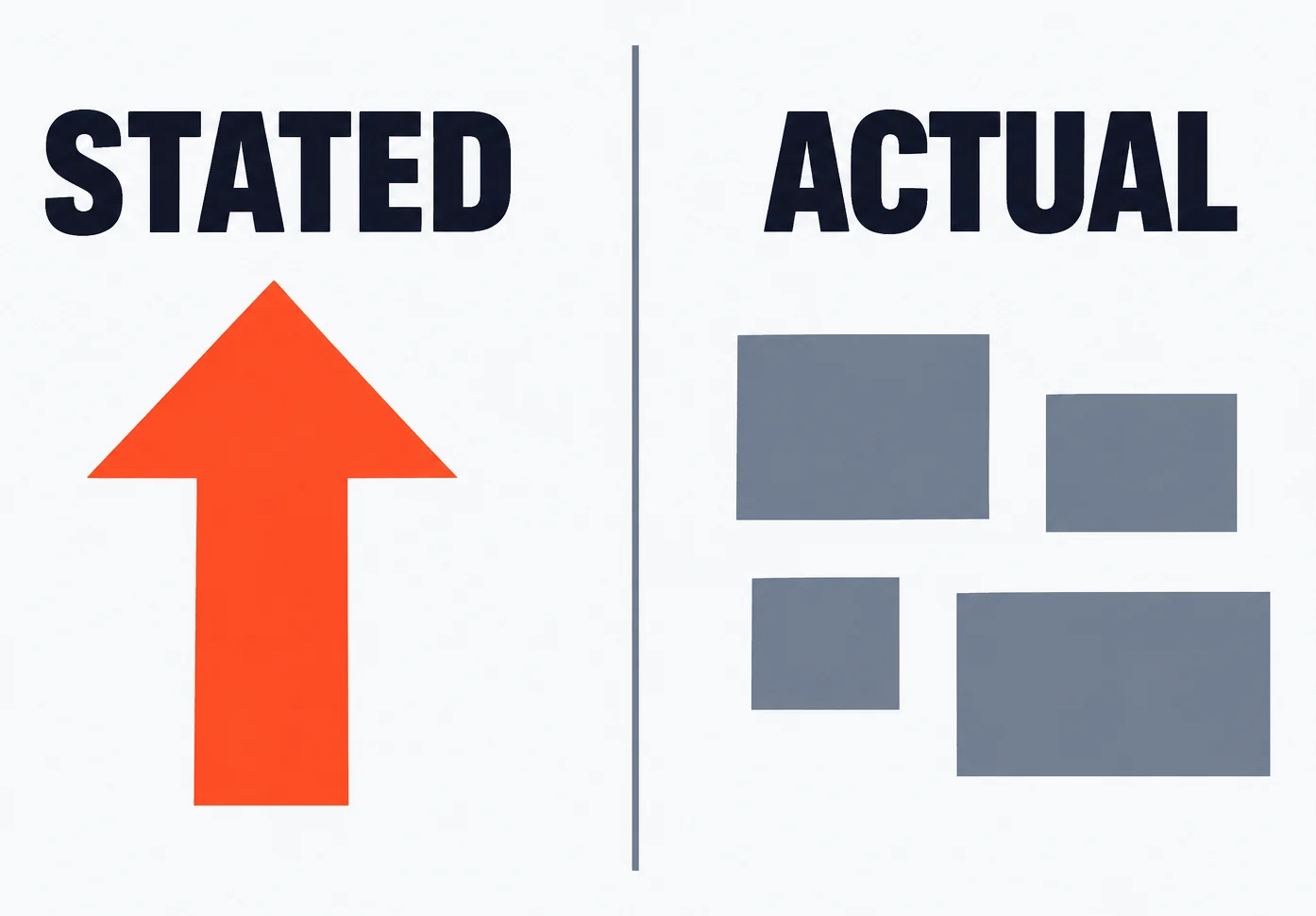
The job loss is real. The stated reason is not.
Everything above is an argument about corporate language, not about the people affected. Those two things should never be blurred.
Losing a job is not an abstraction. It is a salary that stops, a loan that does not, a visa that becomes a countdown, a family that has to be told. Being cut is hard enough without also being handed a reason that implies you were replaceable by a chatbot. That reason protects the people who made the decision, not the people living with it.
So when we say the AI explanation is usually false, we are not saying the AI job losses were exaggerated for the people who went through them. We are saying they were mislabelled, and that the label was chosen for someone else's benefit. The damage is real. The story attached to it is marketing.
Where AI is genuinely changing things: hiring, not firing
The real effect of AI on employment is not visible in exit interviews. It is visible in job boards that stay empty.
Companies are far more willing to not create a role than to remove a person. Removing someone costs severance, morale, legal exposure and internal trust, and it has to be announced. Never opening the requisition costs nothing and is never reported anywhere. So the team that would have grown from eight to eleven stays at eight, a hiring freeze gets extended one more quarter, and the extra work is absorbed by people already there who now have tooling that makes absorbing it plausible.
This is why the public conversation about AI and jobs keeps missing the point. It is counting the people who left. The number that matters is the one nobody publishes: the roles that were never opened.
Why entry-level hiring absorbs the damage first
Entry-level hiring is where this bites hardest, because junior roles were always an investment rather than a purchase. You accept lower output for a year or two in exchange for someone who understands your systems by year three.
That trade only works if you are confident about year three. When budgets tighten and a senior engineer with good tooling can cover the routine end of the work, the investment gets postponed. Nobody decides to stop training juniors. They just decide to start next year, and then decide it again.

AI is not mainly taking jobs from people who have them. It is taking the first job from people who do not have one yet.
What this looks like in India
In India the effect shows up most clearly in campus hiring. Offer counts get trimmed, onboarding dates slip by two quarters, and the gap between an offer letter and an actual joining date stretches long enough that the offer stops being a plan.
That kind of reduction never appears as a layoff, because legally and publicly it is not one. A fresher role that was never posted generates no headline, no severance and no coverage. It is the cheapest cut a company can make, which is exactly why it goes first.
The work that has genuinely shrunk
Some categories of work really have contracted, and it is worth being specific about which rather than gesturing at the whole economy. Bulk content writing produced for volume rather than for readers. Basic translation. Tier-one support that was already a script someone read aloud. Simple data entry moving values from one place to another.
That is real, and it is a far narrower list than the announcements imply. Notice what those four have in common: each was already close to mechanical before any model touched it.
How to test any layoff blamed on AI
Claims about AI layoffs can be checked from outside the company. Three questions work on any announcement you read.
- Did revenue per employee go up? Headcount going down is not efficiency by itself. If the same output now comes from fewer people, the ratio moves. If only the denominator moved, nothing was automated.
- Does the same amount of work still ship? Fewer people plus fewer features, slower releases and a longer support queue is not automation. It is reduced capacity with better branding.
- Does the role stay closed? Watch for six months. If the same job title reappears in a lower-cost location, the work was not automated. It was relocated.
Most layoffs blamed on AI fail all three. The failure is not even subtle: the job postings are usually public, and the reappearance is easy to find if anyone bothers to look. That nobody looks is the point. The claim was never meant to be checked, only repeated.
Common questions about layoffs blamed on AI
Are layoffs really caused by AI?
Rarely in the direct sense implied. Most cuts trace back to over-hiring corrections, expensive capital, cancelled projects or relocated work. AI is usually the description attached afterwards, not the mechanism that made the roles unnecessary.
Why do companies say AI caused the layoff then?
Because it is the only available reason that reflects well on management. Every alternative explanation is an admission of a forecasting error, a demand problem or a failed bet. "AI efficiency" converts a cost decision into a strategy announcement, and the market rewards the conversion.
Is AI actually reducing entry-level hiring?
This is where the effect is most visible. Entry-level roles are the easiest to quietly not open, they carry the weakest internal advocates, and the routine work that justified them is the work current tooling covers best. The result is a narrowing pipeline rather than a wave of firings.
Which jobs has AI genuinely replaced?
The honest list is short and specific: bulk content writing, basic translation, scripted tier-one support, and simple data entry. Work that was already mechanical before automation arrived. Most other claims do not survive the three tests above.
What was never really a job
Here is the part we believe from building software for other companies: a lot of the work being "automated away" was never really a job. It was a gap where software should have existed and did not.
We see this constantly. Someone spends two hours a day copying values from one system into another, or retyping an order that already exists in a different database. That was never a job. It was a missing integration that a person was hired to stand in for. Most of the custom business software we build exists to close gaps exactly like that, and the honest framing is that we are removing a task the company should never have created.
That distinction matters more than any of the announcements do. Removing the work is good. Removing the person and calling it progress is a different act, and the two get deliberately confused. If the work genuinely disappears, the person is free for work that actually needed a human. We have written before about when building custom software is actually worth it, and the same test applies here: if you cannot name the specific work being removed, you are not automating anything.
We do not have a fix for tech layoffs and we are not going to pretend otherwise. What we have is a bias toward being specific. If someone tells you AI did it, ask which work, done by whom, and what does it now instead. If you want to argue with any of this, or you have a process that looks suspiciously like a missing integration, tell us what it looks like.